

Resilience has become a structural requirement for manufacturing. What was once an occasional disruption is now a permanent operating condition. Raw material and energy prices fluctuate sharply, supply chains face geopolitical risks, and customer demand shifts faster than production systems were built to handle. Resilience isn't just about protecting output anymore. It's about staying competitive under continuous uncertainty.
Traditional Responses Add Buffers, Not Adaptability
Manufacturers have responded with familiar strategies: reshoring operations, increasing safety stock, strengthening supplier relationships, and diversifying sourcing. These measures improve continuity by adding buffers. They make systems more robust but not more adaptive, and they usually come at significant cost.
Digital Tools Help, but Remain Largely Isolated
Digital technologies are playing a bigger role in resilience strategies, though most efforts focus on operational performance at the asset and process level. Plants invest in predictive maintenance, AI-enhanced condition monitoring and maintenance, and quality management tools that use machine learning to catch defects earlier.
Digital twin and simulation deployment are increasingly growing and helps shorten engineering cycles and reduce risk.
These are useful advances. They improve uptime, quality, and efficiency. But they're usually implemented as point solutions. Integration remains the major challenge.
Figure 1: Integration is the major challenge to adoption of digital projects: *
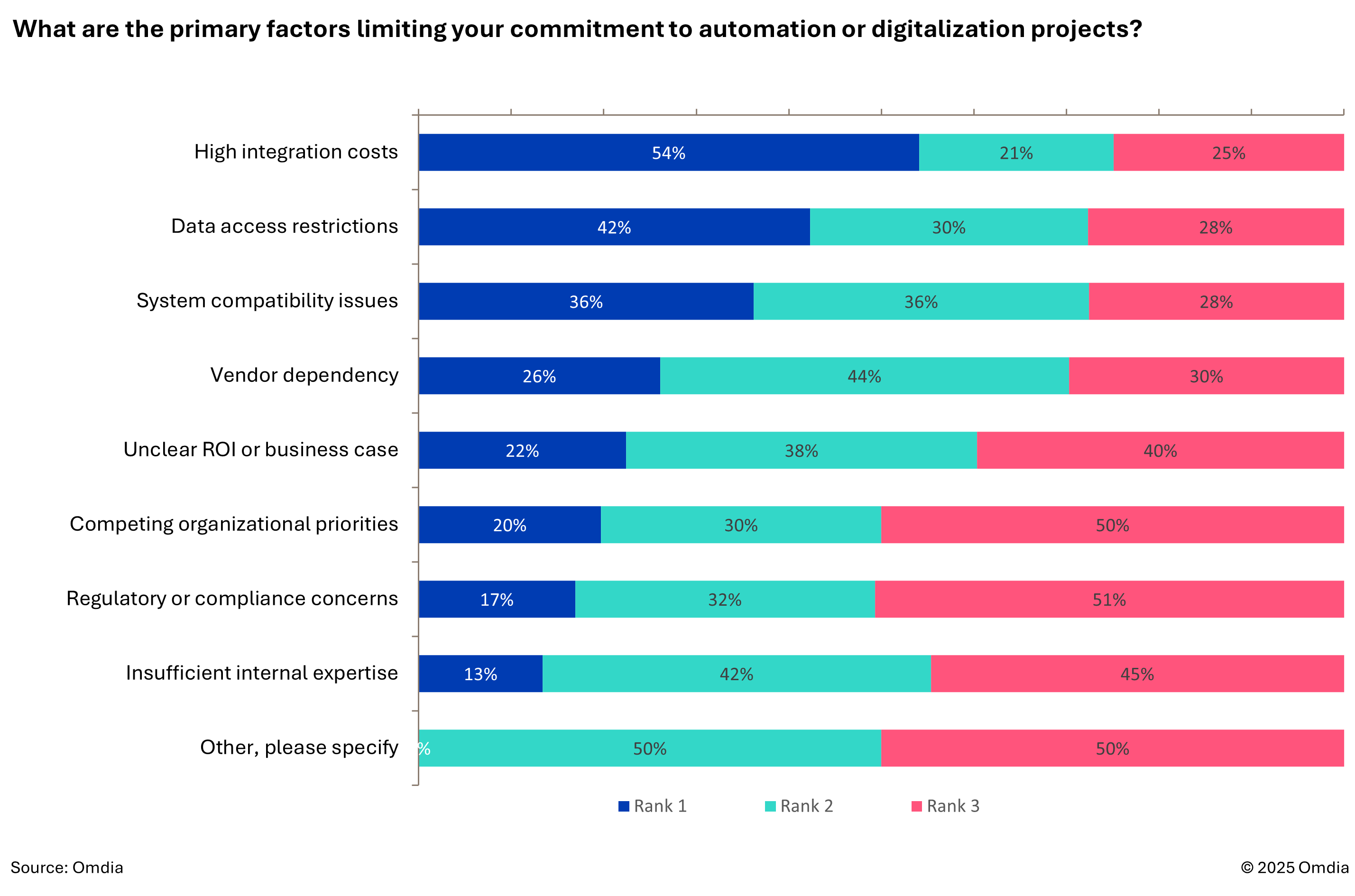
N=320
Software-Defined Automation: The Architectural Shift
A key, and still underappreciated, lever for resilience is software-defined automation (SDA). SDA is often discussed narrowly - as the virtualization of control or as a way to reduce dependence on dedicated hardware. That's part of it, and it's relevant. But it misses the larger point. The real value of SDA lies in enabling a software-centric, adaptable manufacturing system that extends beyond the production line.
How It Works
SDA rests on three core capabilities: software-based virtualization that reduces hardware dependence, real-time data availability and mobility across all layers, and centralized orchestration.
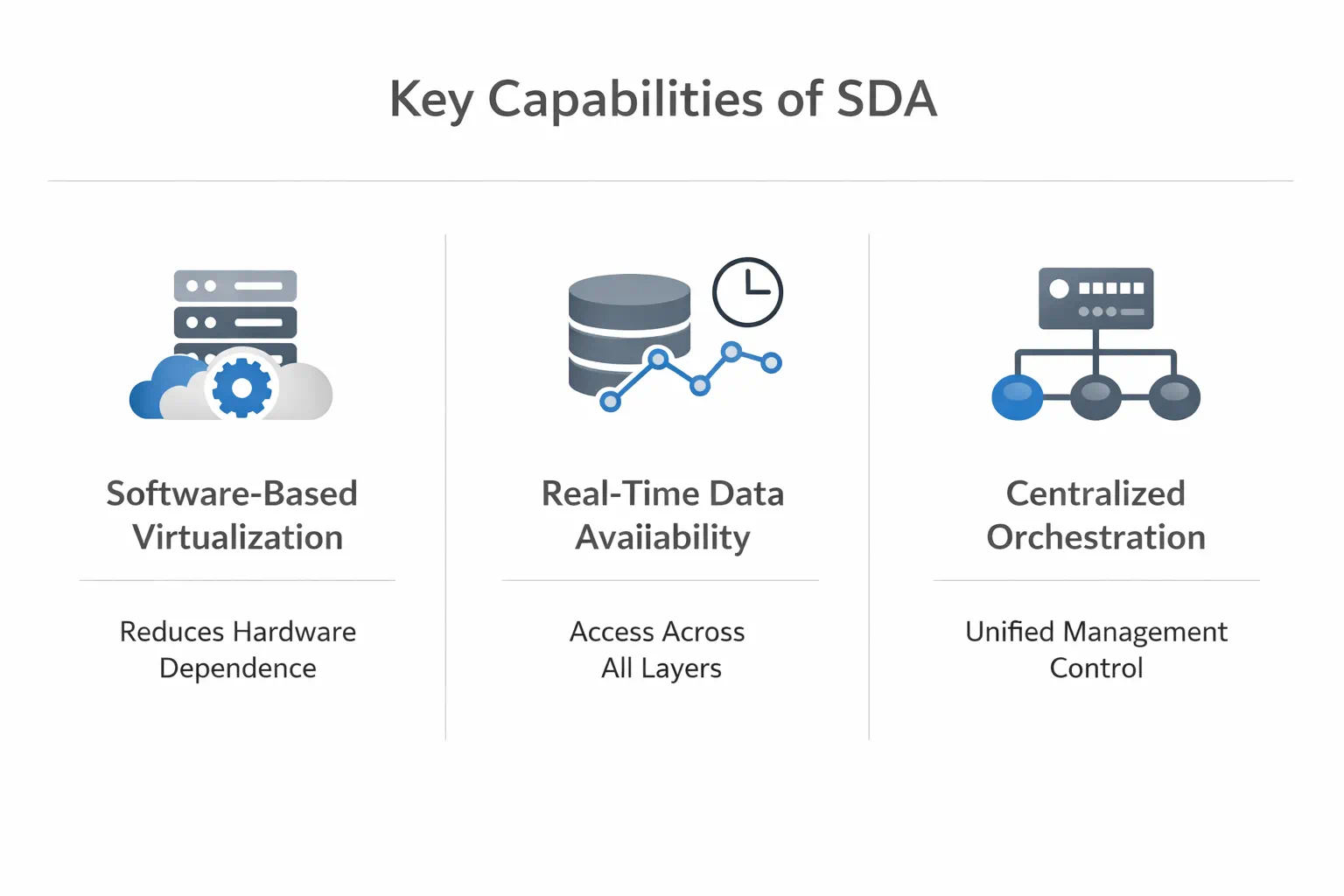
These capabilities translate into practical gains. Traditional automation requires significant hardware engineering, cabinet changes, and commissioning work when expanding capacity or adapting control structures. SDA makes automation resources configurable and scalable in software, cutting both time and cost—including upfront hardware investment.
Gains: Customer report approximately 2x faster system development and commissioning or 30% lower design and engineering costs while adopting an SDA solution. *
A virtualized environment also improves recoverability and lifecycle control. Software-defined setups handle standardized deployment, rollback, and redundancy better than isolated hardware-bound systems. This means fewer delays when changes are needed and faster recovery when failures occur.
System-Level Gains
More importantly, SDA creates system-level resilience by improving how data and functionality connect across manufacturing.
Integration foundation: The data layer in SDA provides a unified foundation for system integration - addressing what has been the major obstacle to deploying changes or introducing digital technologies.
Lifecycle optimization: It builds a stronger foundation for product lifecycle optimization - linking product design, supply, production, customer service, product services, new business models, collaboration frameworks, and end-of-life processes more effectively.
This matters because resilience is increasingly a lifecycle issue, not just a plant-floor issue. The more fragmented the system, the harder it becomes to coordinate responses to supply shifts, energy price changes, and circularity obligations.
SDA is also foundational for the next phase of industrial digitalization. AI and autonomous orchestration will only create value if they can access timely, contextualized operational data. That requires an architecture capable of supporting them.
From Buffers to Adaptability
Manufacturers will keep using sourcing strategies, buffers, and targeted digital applications. Those remain necessary. But the larger gains will come from improving the adaptability of the production system itself - whether it can absorb change, adapt efficiently, and support optimization across the full lifecycle.
Interest in software-defined automation is growing as manufacturers recognize its role in building resilience. Our latest surveys and interviews show that over 60% of manufacturers are ready to move beyond evaluation and begin pilot implementations within the next year.
Want to dive deeper into this evolving landscape? Read our recent e-book on building resilience amid a world of geopolitical and supply chain disruption.
*Schneider Electric - Omdia Study: Open vs. Closed: The $11.28m Question for Industrial Leaders
More from author
b942.jpg)

More insights
Assess the marketplace with our extensive insights collection.
More insightsHear from analysts
When you partner with Omdia, you gain access to our highly rated Ask An Analyst service.
Hear from analystsOmdia Newsroom
Read the latest press releases from Omdia.
Omdia NewsroomSolutions
Leverage unique access to market leading analysts and profit from their deep industry expertise.
Solutions